
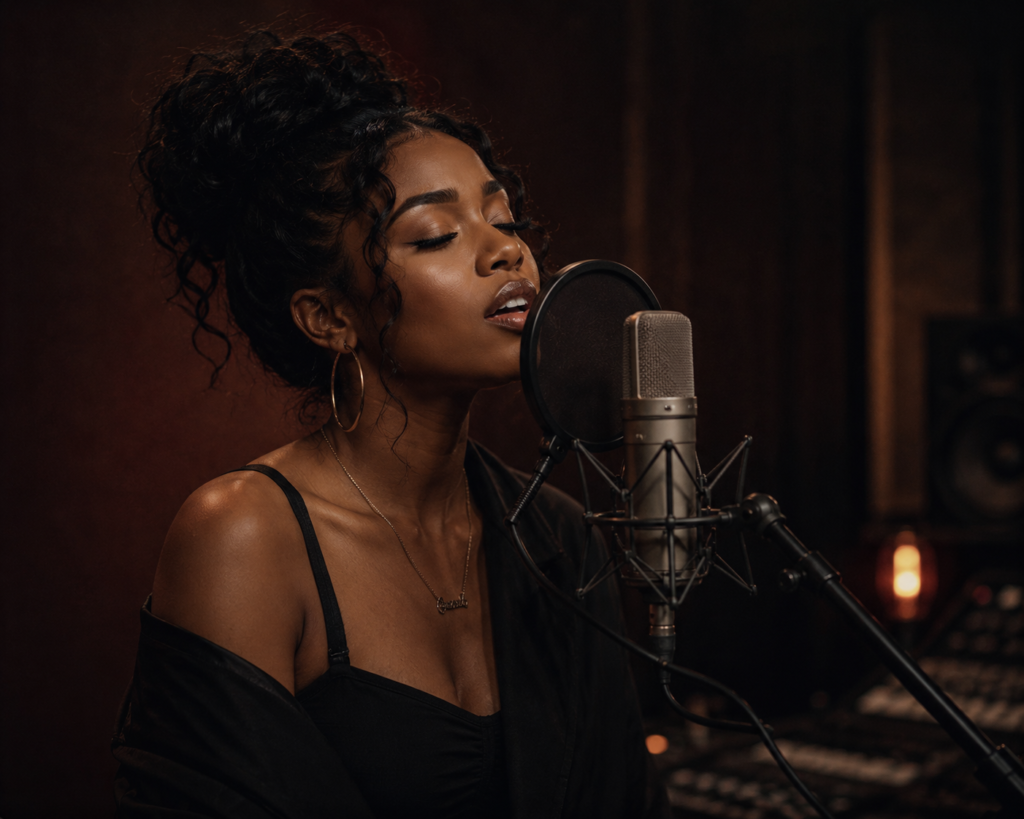
I’ve worked with a lot of vocalists over the years, and I keep running into the same problem. Talented artists, genuinely strong voices, who train completely wrong without realizing it.
It’s not that they’re not working hard. Most of them are working very hard. The issue is where that effort is going.
Hitting the Note Isn’t the Goal
Most artists train to hit the note. They run scales, they practice the melody until it’s clean, and they call that progress. And technically, it is progress. But it’s not the whole picture.
What I listen for in a session isn’t whether you can hit the note. It’s whether the note is coming from the right place. A voice that hits a note from the throat sounds different from a voice that hits the same note from the core. One tires out after twenty minutes. The other can carry a full set.
This is the first thing I work on with almost every artist — getting the voice to come through the diaphragm with real, maximized flow. It’s not the exciting part of training. It doesn’t feel like progress in the moment. But it’s the part that determines whether you’ll still sound good an hour into a live show.
You’re Probably Practicing for the Wrong Room
Here’s something most artists don’t think about until it’s too late: a recording booth and a stage demand two completely different things from your voice.
In the studio, you can punch in, retake, adjust levels, layer harmonies after the fact. Your voice gets a lot of help. On stage, none of that exists. It’s just you, the mix, the crowd noise, and whatever control you actually have over your instrument in that moment.
I see artists who sound incredible on a recorded track completely lose that quality live, not because their voice changed, but because they trained almost entirely for the studio. If you know a live performance is coming, your preparation needs to shift toward that environment specifically — projection, stamina, breath control under pressure, and the ability to recover mid-song if something goes off.
Harmony Is a Skill, Not a Talent
A lot of artists think blending into harmony is something you either have a natural ear for or you don’t. I disagree. It’s a trainable skill, and it’s one of the most overlooked parts of vocal development.
Being able to hear where your voice sits within a larger sound, and adjusting in real time to support that sound rather than fight it, takes deliberate practice. It’s not about being the loudest voice in the room. It’s about understanding exactly where you fit, and owning that space completely.
What Actually Works
If I had to simplify everything I focus on with artists into a short list, it would be this:
Train the breath before you train the note. Practice in the environment you’re actually going to perform in, not just the one that’s most comfortable. Treat harmony as a skill you build, not a gift you either have or don’t. And critique tediously — not to discourage, but because the artists who improve the fastest are the ones willing to hear exactly what isn’t working yet.
None of this is flashy. It won’t show up in a thirty second clip. But it’s the difference between a voice that sounds good once, and a voice that holds up for an entire career.
— Yolanda Byrd